The Fundamentals Of Elite Sports Training
To truly excel at finishing, players must first master foundational techniques. This isn’t just about getting the ball in the hoop; it’s about developing the muscle memory and coordination that allow for high-percentage shots under pressure. By April 2026, the emphasis in basketball training has shifted towards comprehensive skill development that builds from the ground up.
At the core of effective layups and finishing moves are precise footwork and hand placement. For a right-handed layup, players typically step with their left foot, then jump off that left foot while extending their right hand towards the basket. The reverse applies for left-handed finishes. This “one-two” rhythm is crucial. Coaches often teach players to drive their knee up on the jumping foot to gain elevation and protect the ball. Similarly, hand placement involves using the fingertips to control the ball, with a gentle wrist flick for a soft touch off the backboard.
Developing ambidexterity is non-negotiable for modern basketball. Players must be equally comfortable finishing with both their left and right hands, and from either side of the basket. This versatility makes them unpredictable and effective against defenders. Comprehensive training programs, such as those offered through Metro West basketball training drills, often integrate drills specifically designed to build this two-sided proficiency, ensuring players are well-rounded.
We identify five essential layup types that form the bedrock of finishing skills:
- Finishing off both feet (quick stop): Useful for power finishes or when expecting contact.
- Left foot – left hand finish: The traditional left-side layup.
- Right foot – right hand finish: The traditional right-side layup.
- Left foot – right hand finish: An inside-hand finish often used to protect the ball from a defender.
- Right foot – left hand finish: The opposite inside-hand finish.
Effective backboard usage is another critical element. Rather than aiming directly for the rim, players are taught to target the inner corner of the backboard square. This provides a larger, more forgiving target and helps create the optimal arc for the ball. Protecting the ball by “chinning” it—tucking it close to the chin on the gather—is a fundamental habit that minimizes turnovers when driving to the basket.
Beyond these individual mechanics, understanding the kinetic chain is vital. This refers to the sequence of movements from the ground up that generates power and control. A powerful drive to the basket often starts with a “negative step” or a slight step back before exploding forward. This technique, used by elite scorers, loads the hips and generates explosive momentum from a standstill, allowing players to burst past defenders and attack the rim with confidence.
Mastering Technique Through Individual Drills
Individual drills are the bedrock of skill development, allowing players to isolate and perfect specific movements without the complexities of game-time pressure. By April 2026, these drills have evolved to be more intentional, focusing on muscle memory and explosive mechanics.
One of the most iconic and effective beginner layup drills is the Mikan Drill. Named after NBA legend George Mikan, this “stupidly simple” drill builds rhythm, touch, and ambidexterity directly under the basket. Players alternate short, quick layups with their right and left hands, catching the ball after each make and immediately going up for the next. The goal isn’t just to make shots, but to develop a fluid, continuous motion. We encourage players to keep their head up, aim for the backboard square, and focus on a soft wrist flick for optimal touch. Challenging oneself to make 50 or even 100 Mikan layups, or to complete them faster, pushes players beyond basic repetition and builds resilience.
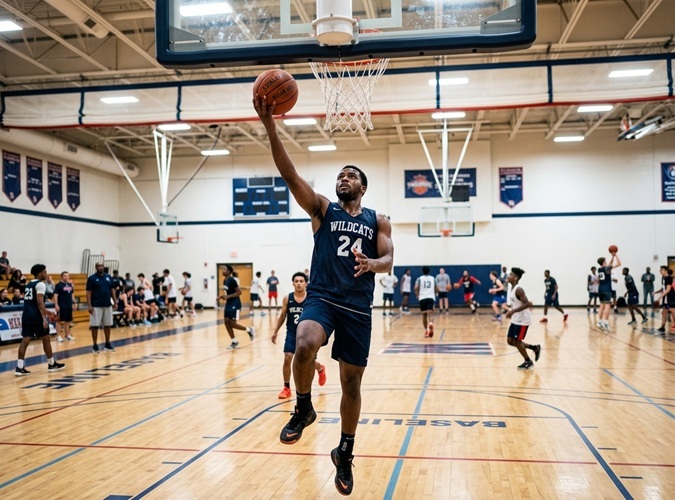
For a deeper dive into explosive finishing mechanics, the 2-Step Layup Drill is invaluable. This drill focuses on the classic one-two footwork, but with an added emphasis on generating power. Players start on the block, take a quick “negative step” (a step back with the foot closest to the baseline), then explode forward with two aggressive steps (right-left for a right-handed finish) before jumping off the inside foot. This negative step loads the hips, allowing for a more powerful and deceptive first move, mimicking how players might freeze a defender before driving. This drill is excellent for building muscle memory for that crucial first step and the subsequent drive. For detailed instructions on executing this, we recommend exploring resources like 2 steps lay ups — Level Up Basketball, which breaks down the setup, load, attack, elevate, and finish components.
Another critical individual drill focuses on extension footwork and the dribble-to-rim transition. Many players take too many dribbles to reach the basket. The Extension Layup Drill teaches players to cover significant ground with just one dribble from the three-point line. This involves a powerful first step that extends with the dribble, allowing the player to maintain stride and attack the rim efficiently. The emphasis is on staying in stride rather than shortening steps, and vocalizing the steps (“Right, left, right, layup!”) can help players struggling with coordination. This drill builds the crucial skill of transitioning from a perimeter catch or dribble to an explosive, efficient drive to the basket.
Practicing layups off the dribble further refines this transition. Starting from the wing, players execute a hard, “downhill” pound dribble, then gather the ball for a two-step layup. This drill develops the ability to accelerate from a standstill, maintain body control, and finish against potential contact. It trains players to keep their eyes up, aim for the top corner of the backboard, and protect the ball on their outside hip during the drive. The goal is to develop the confidence and technique to attack the rim aggressively and finish strong, rather than drifting sideways.
These individual drills, when practiced consistently, build the fundamental muscle memory, footwork precision, and body control necessary for high-percentage finishing in any game situation.
Advanced Finishing & Dynamic Sports Training
While foundational layups are crucial, modern basketball demands a broader repertoire of advanced finishing moves beyond the basic two-step. Players must develop “craftiness around the rim” to navigate increasingly sophisticated defenses and taller, more athletic shot-blockers. By April 2026, training emphasizes not just what moves to perform, but when and how to perform them with maximum effectiveness.
Key advanced finishing moves include:
- Euro Step: A deceptive move where a player takes a step in one direction, then quickly shifts their body and takes a second step in a different direction, creating separation from a defender.
- Pro-Hop (Jump Stop Power Finish): Involves stopping on two feet after a drive, allowing for a balanced, powerful jump straight up through contact, or to pivot for an alternative shot.
- Floater/Teardrop: A soft, high-arching shot released over outstretched defenders, often used by smaller guards to score over taller opponents.
- Reverse Layup: A finish on the opposite side of the basket from where the drive originated, often used to avoid a defender in the paint.
- Finger Roll: A delicate finish where the ball is rolled off the fingertips, often with spin, to guide it gently into the hoop.
Mastering these moves requires not only physical skill but also strategic thinking, allowing players to have “A, B, and C options” when attacking the rim. This versatility, exemplified by players like Kyrie Irving and his Mikan variations, makes a player incredibly difficult to guard.
To truly integrate these advanced finishes into a player’s game, coaches are increasingly turning to dynamic sports training methods like interleaving and randomization. Traditional “block practice,” where players repeat the same move repeatedly, can lead to impressive performance in practice but often fails to transfer to game situations. This is because games are inherently random and unpredictable.
Interleaving involves mixing different skills or finishing moves within a single drill. For example, instead of doing 20 straight Euro steps, a drill might require a Euro step, then a floater, then a power finish. This forces players to constantly adapt and make decisions, much like in a real game.
Randomization takes this a step further by varying angles, starting points, dribble moves, and even the type of finish required within a drill. Instead of attacking the rim from the same spot every time, players might attack from different cones around the arc, choosing their finish based on an imagined defender or a coach’s call. This approach, often seen in drills like “Arc Finishing” or “Figure 8 Hook Shots,” builds adaptability and decision-making skills.
The contrast between these methods is stark:
Feature Block Practice (Traditional) Random Practice (Game-Realistic) Skill Focus Repetitive execution of one specific move Varied execution, decision-making, and adaptability Game Transfer Often low; “Practice hero, game zero” High; Builds skills directly applicable to game situations Engagement Can be monotonous, leading to mental disengagement More engaging, mentally stimulating, and challenging Learning Focus on “how to do it” Focus on “when and why to do it” Efficiency Appears efficient in practice, less so in games More efficient for long-term skill acquisition and game performance By embracing interleaving and randomization, coaches can create practice environments that more closely mirror the chaos and unpredictability of a real game. This not only improves a player’s ability to execute advanced finishes but also enhances their decision-making under pressure, making them truly crafty around the rim.
Competitive Drills & Game-Speed Conditioning
One of the most common frustrations for coaches and players alike is the disconnect between practicing layups every day and still missing them during games. The answer, often, lies in the lack of competitive drills that simulate game-like pressure and incorporate defenders. By April 2026, it’s widely understood that to reduce game-time misses, practice must evolve beyond static layup lines.
Competitive layup drills are designed to introduce decision-making, physical contact, and defensive pressure, forcing players to execute their finishes under duress. Drills like 1v1 Arc Finishing (where an offensive player attacks from various cones around the arc against a live defender) or Baseline 1v1 Escape provide direct one-on-one scenarios. These drills teach players to read defenders, protect the ball, and choose the appropriate finish. Adding rules like allowing the defender to “bump with a pad” but not block or steal the ball helps players practice finishing through contact without excessive risk.
Transition speed and conditioning are equally vital, as many scoring opportunities arise from fast breaks. Full-court drills integrate finishing with dribbling, passing, and sprinting, improving overall athleticism and game readiness. The Russian Layups drill is an excellent example: players make a long pass downcourt, sprint to receive a return pass, and finish with a layup, then rotate. This continuous motion builds stamina while refining full-speed finishing. Similarly, the 2-Minute Full-Court Left-Hand Lay-up Drill challenges players to make a high volume of left-handed layups within a strict time limit, combining conditioning with weak-hand development. Coaches often set ambitious goals (e.g., 75 makes for high school boys varsity) and add consequences for failure, fostering a competitive, high-intensity environment.
These drills also hone crucial skills like decision-making and the ability to handle pressure simulation. In a Half-Court 2-on-1 drill, for instance, offensive players must quickly decide whether to pass or drive based on the lone defender’s position. The “Around the Arc” drill can be modified to include a trailing defender who can only enter the arc after the offensive player attacks, simulating the pressure of a recovering defender.
Furthermore, simulating help-side defense is critical. Drills like “Defense Cones Closer” or “1v1 Attack with Cones” can position cones to represent help defenders, forcing the offensive player to adapt their attack angle or finishing move to avoid the “imaginary” help. This teaches players to anticipate defensive rotations and adjust their approach accordingly.
Effective competitive drills often include:
- Limited balls: Using fewer balls than players increases urgency and focus.
- Clear goals and consequences: Setting challenging but achievable targets with team-based rewards or consequences (e.g., “second chance” half-court shot to avoid running) fosters motivation and teamwork.
- Full speed: Emphasizing game speed from both offense and defense ensures the skills practiced transfer effectively.
- Communication: Encouraging players to call out names for passes and communicate on defense enhances team play.
By incorporating these types of competitive, high-intensity drills, teams can bridge the gap between practice performance and game-day execution, ensuring that those daily layup repetitions translate into successful scores when it matters most.
Conclusion
Mastering basketball layups and finishing moves is a journey that evolves from fundamental technique to advanced, game-realistic application. As we look towards April 2026, the emphasis on consistency, skill scalability, and long-term development remains paramount. By understanding the nuances between a basic layup and a versatile finishing move, players can systematically build their arsenal around the rim.
The integration of individual drills like the Mikan and 2-step layups builds essential muscle memory and ambidexterity. Progressing to advanced finishes like Euro steps and floaters, coupled with dynamic training methods such as interleaving and randomization, ensures that these skills are not just learned but can be executed effectively under pressure. Finally, competitive, full-court drills simulate the intensity and decision-making demands of actual games, improving conditioning, passing, and finishing at speed.
Practice efficiency is key. Moving beyond traditional, repetitive drills to embrace game-realistic scenarios with defenders and varied situations is crucial for true skill transfer. This approach not only enhances individual performance but also fosters team chemistry through shared challenges and successes. By setting clear goal setting and continuously pushing boundaries, players can significantly elevate their April 2026 performance metrics and become formidable forces in the paint.
Frequently Asked Questions
Frequently Asked Questions about Sports Training
Effective sports training is a blend of physical conditioning, skill acquisition, and mental fortitude. Key considerations include understanding optimal practice frequency for skill retention, recognizing equipment needs that can enhance training, adapting drills for different training age and skill levels, and utilizing methods for performance tracking to monitor progress.
Why do players miss layups in games despite daily practice?
Players often miss layups in games despite consistent practice due to several factors:
- Lack of competitive pressure: Traditional layup lines lack defenders, contact, and game-speed decision-making.
- Block practice limitations: Repeating the same move in isolation doesn’t prepare players for the random, unpredictable nature of a game.
- Insufficient game-speed simulation: Practicing at a slower pace than game intensity leads to execution breakdowns when speed increases.
- Absence of defensive contact: Players aren’t accustomed to finishing while being bumped, pushed, or having defenders in their space.
- Mental focus: The added pressure of a game, crowd, and stakes can impact concentration and confidence.
To counteract this, coaches must integrate competitive, randomized drills with live defenders that simulate real game situations.
What is the difference between a layup and a finishing move?
The terms “layup” and “finishing move” are related but distinct:
- Layup: Refers to the most basic, fundamental shot taken close to the basket, typically involving two steps and releasing the ball off the backboard with one hand. It’s often taught as a foundational basic technique.
- Finishing Move: Is a broader category encompassing any shot taken close to the basket, including layups, but also incorporating a wider range of advanced variations. This includes moves like Euro steps, pro-hops, floaters, reverse layups, finger rolls, and power finishes. The goal of a finishing move is to score effectively in traffic and demonstrate versatility around the rim, adapting to defenders and angles. While a layup is a type of finishing move, not all finishing moves are simple layups.