Key Takeaways:
- Biofilms are persistent communities of microorganisms that can negatively impact water treatment systems by contaminating water and damaging equipment.
- Traditional methods for controlling biofilms often fail to completely eradicate these communities, leading to recurring issues.
- Emerging technologies, including nanomaterials, enzymatic treatments, and photonic techniques, offer more effective and sustainable solutions for biofilm management.
- Integrated, multifaceted strategies hold the greatest promise for efficient, lasting biofilm control in water treatment facilities.
Understanding Biofilm Formation
Biofilms are complex microbial communities that adhere to surfaces within water treatment systems and form a dense, protective extracellular polymeric substance (EPS) matrix. This structure enables biofilms to shield themselves from chemical and mechanical removal efforts, making them especially difficult to manage. The persistence and resilience of these communities are at the heart of multiple operational and health challenges across the water treatment industry. The issue is particularly acute in critical components such as pipes, filters, and membranes, where biofilm buildup reduces system efficiency, increases maintenance requirements, and poses a risk of microbial contamination.
Several regions have adopted dedicated biofilm control solutions California to combat the unique environmental pressures and regulatory standards involved in water treatment. Implementing effective biofilm management protocols is essential for both public health and the longevity of expensive infrastructure assets.
Limitations Of Traditional Biofilm Control Methods
Historically, water treatment facilities relied on chemical disinfectants and mechanical cleaning to control biofilms. While these methods can temporarily reduce biofilm, they rarely fully eradicate microbial communities. Chemicals like chlorination struggle to penetrate the EPS matrix, often leaving residual biofilm that can quickly regrow after treatment. Excessive chemical use increases costs, fosters resistant strains, and causes environmental concerns due to runoff. Mechanical methods, such as scrubbing and water jets, are labor-intensive, limited in reach, and often fail to eliminate biofilm at its source. Consequently, recurring biofilm problems disrupt operations, underscoring the need for better strategies.
Emerging Nanomaterial-Based Strategies
Nanotechnology has emerged as a powerful tool in advancing the fight against persistent biofilms. Nanoparticles such as silver, copper, and zinc oxide exhibit enhanced antimicrobial activity due to their high surface area and direct interaction with microbial cells within the protective biofilm matrix. Silver nanoparticles, in particular, have been extensively examined for their capacity to disrupt cell membranes and inhibit key biological processes underpinning biofilm survival.
Enzymatic Treatments For Biofilm Disruption
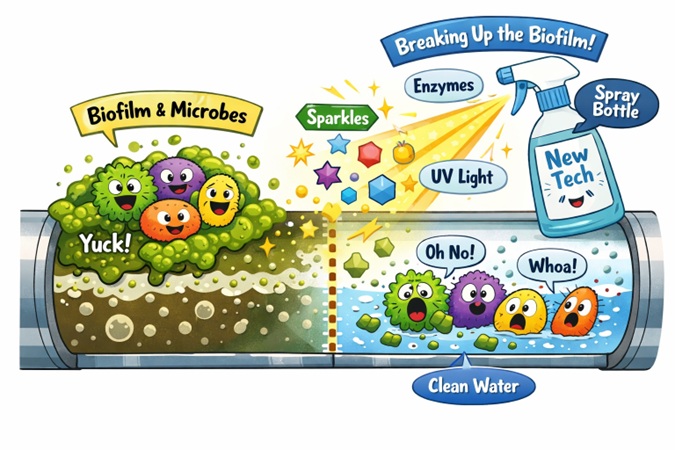
Another innovative approach involves targeting the structural integrity of the EPS matrix with specialized enzymes. Enzymatic agents such as DNase I and lysostaphin can degrade extracellular DNA and proteins essential to biofilm cohesion, thereby ‘unlocking’ biofilms from their protective shell. These treatments have proven effective against notoriously persistent bacteria such as Staphylococcus aureus and S. epidermidis. Notably, enzymatic products have shown stability through sterilization processes and are biocompatible—making them promising for broad deployment in existing water treatment settings. The delicate action of enzymes allows for simultaneous reduction of biofilm mass and increased susceptibility of remaining cells to other control measure
Physical & Photonic Techniques
In recent years, physical and photonic methods have emerged as complementary strategies in the battle against biofilm formation. Ultraviolet (UV) light, especially UV-C at 254 nm, has a significant capacity to disrupt biofilm structure and reduce microbial viability. A growing body of evidence, as summarized by the Centers for Disease Control and Prevention, supports the inclusion of photodynamic therapy and targeted irradiation techniques within multi-layered water treatment protocols. These non-chemical methods not only reduce reliance on harsh disinfectants but also reach surfaces and system components that biological and chemical treatments sometimes miss.
Integrating Multiple Approaches For Effective Biofilm Management
The most robust solutions to biofilm contamination combine several advanced techniques into integrated management systems. For instance, coupling nanomaterials with enzymatic cleaning agents attacks both microbial cells and the EPS matrix simultaneously, leaving biofilm little opportunity for survival or regrowth. Incorporating physical treatments such as UV irradiation at critical system points can further enhance overall biofilm destruction. A comprehensive review in Frontiers in Cellular and Infection Microbiology notes that multimodal interventions consistently outperform single-strategy approaches, both for biofilm removal and for preventing recurrence. Facilities investing in an integrated, evidence-based approach set themselves up for long-term operational success and regulatory compliance.
Conclusion
Biofilm management in water treatment has entered a new era, driven by advances in nanotechnology, enzymatic disruption, and physical intervention methods. While traditional approaches alone have proven insufficient, innovative and integrated solutions offer water treatment operators improved outcomes, higher system reliability, and reduced public health risks. As facility managers and engineers continue to adapt and refine these strategies in line with emerging research, communities stand to benefit from cleaner water and more sustainable infrastructure. Ongoing investment in science-backed interventions is essential to keep pace with evolving threats posed by biofilms, secure public trust, and ensure regulatory compliance in the future.