
Defining Modern Digital Marketing Strategies
The digital marketing landscape is transforming at an unprecedented pace. In 2026, global digital ad spending is projected to reach nearly $1 trillion. This massive investment, coupled with an annual growth rate of 13.9%, highlights immense competition and opportunity online. Many marketers report that the industry has changed more in the past two years than in the previous fifty combined.
Despite this rapid evolution, a significant number of businesses — nearly 47% — still operate without a formal digital marketing strategy. This leaves them vulnerable in a market where 75% of marketers have already adopted AI to gain an edge. Without a clear plan, efforts can be scattered, resources wasted, and growth stifled.
We understand the challenges and the critical need for a well-defined approach. In this comprehensive guide, we will explore what truly constitutes a robust digital marketing strategy. We’ll differentiate it from mere campaigns and tactics. We will also delve into its essential components, from setting SMART goals and understanding buyer personas to leveraging the core digital channels. We will examine how artificial intelligence, automation, and analytics are reshaping the field in 2026. Finally, we will provide actionable steps to build, optimize, and measure a strategy that drives real results for your business.
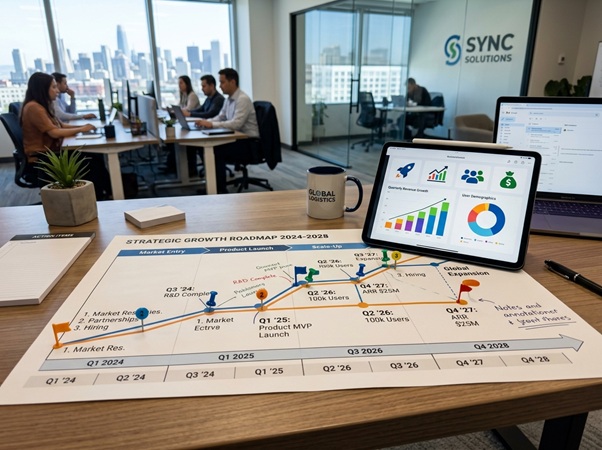
In the dynamic digital realm of 2026, a digital marketing strategy serves as a high-level, long-term roadmap that aligns all online marketing efforts with overarching business objectives. It’s the “why” and “what” behind your marketing activities, providing a clear vision for how your company will establish an internet presence to reach, engage, and convert your target audience, ultimately driving revenue. Unlike isolated marketing activities, a true strategy offers a cohesive framework for decision-making across all digital channels, from your website to social media, email, and search engines.
A digital marketing strategy is distinct from campaigns and tactics. While all three are interconnected, they operate at different levels of granularity and timeframes. A strategy provides the overarching direction, while campaigns are specific initiatives designed to achieve particular goals within that strategy, and tactics are the individual actions taken to execute those campaigns. For a deeper understanding of how these elements intertwine, exploring resources like those on Cortex digital marketing strategies can provide valuable insights into integrated approaches.
At its core, an effective digital marketing strategy is built around four key components: well-defined goals, a deep understanding of your audience, a realistic budget, and clear metrics for success. These components ensure that every effort is purposeful and measurable. Setting SMART (Specific, Measurable, Achievable, Relevant, Time-bound) goals is fundamental, as it translates broad business objectives into concrete marketing targets. For instance, instead of aiming for “more sales,” a SMART goal might be “increase qualified leads by 30% through targeted LinkedIn campaigns within the next six months.”
Furthermore, a robust strategy considers the interplay of owned, paid, and earned media. Owned media includes your website, blog, and social media profiles – channels you fully control. Paid media encompasses advertising like PPC, social media ads, and display ads, where you pay to amplify your message. Earned media, such as PR mentions, reviews, and organic social shares, is the result of positive word-of-mouth and provides invaluable third-party validation. A balanced mix of these three types of media is essential for a comprehensive and resilient digital presence.
Aspect Digital Marketing Strategy Digital Marketing Campaign Digital Marketing Tactic Purpose Overarching plan to achieve long-term business goals Focused initiative to achieve specific campaign goals Individual action to execute a campaign Timeframe Long-term (e.g., 1-3 years) Medium-term (e.g., 3-6 months) Short-term (e.g., daily, weekly tasks) Scope High-level vision, defines “what” and “why” Specific objectives, defines “who” and “where” Granular actions, defines “how” Example Increase market share by 20% within 12 months Launch a LinkedIn lead generation campaign Create weekly thought leadership posts on LinkedIn Focus Direction, alignment, resource allocation Specific audience, messaging, channel selection Content creation, ad setup, email send, website update Differentiating Strategy from Campaigns
While a strategy sets the long-term direction, digital marketing campaigns are medium-term initiatives with specific, measurable objectives. These campaigns are designed to execute a portion of the overall strategy. For example, if your strategy is to increase brand awareness, a campaign might focus on launching a new product through a series of social media ads, influencer collaborations, and email blasts over a three-month period. Campaigns are time-bound, have a defined budget, and target a particular segment of your audience with tailored messaging. They are the tactical deployments that bring your broader strategic vision to life.
Aligning Tactics With Business Goals
Tactics are the granular, short-term actions that make up a campaign. These are the day-to-day tasks: writing a blog post, designing an ad creative, scheduling social media updates, or optimizing a landing page. Each tactic should directly contribute to the success of a campaign, which in turn supports the overall digital marketing strategy and, ultimately, your business goals. Without a clear strategic framework, tactics can become “random acts of marketing,” leading to wasted resources and a lack of measurable impact. Aligning tactics with business goals ensures that every effort, no matter how small, is purposeful and contributes to the desired outcomes. This structured approach is vital for avoiding common pitfalls and ensuring that your marketing investments yield tangible returns.
Core Levers Of A High-Performance Marketing Mix
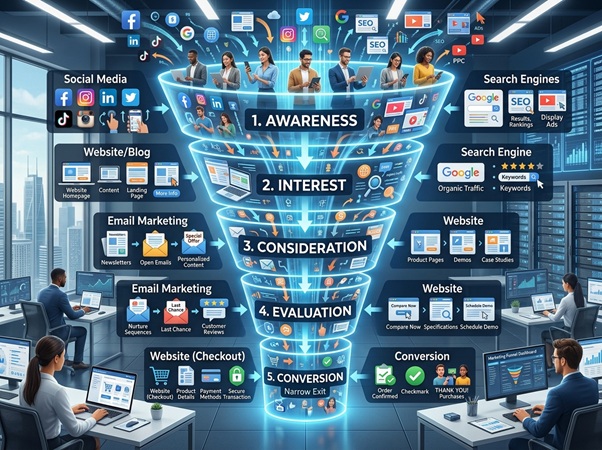
A truly high-performance digital marketing strategy in 2026 leverages a diverse mix of channels, each serving a specific purpose in the customer journey. This multi-channel approach ensures that businesses can attract, engage, and convert prospects effectively.
Inbound Marketing: This philosophy focuses on attracting customers by creating valuable content and experiences tailored to them. Instead of pushing products, inbound marketing draws customers in through helpful information, solving their problems and building trust. It’s about being found when customers are actively looking for solutions.
Content Marketing: At the heart of inbound, content marketing involves creating and distributing valuable, relevant, and consistent content to attract and retain a clearly defined audience. This includes blog posts, articles, e-books, whitepapers, case studies, and infographics. Content not only educates potential customers but also establishes your brand as a thought leader.
Video Marketing: The power of video continues to surge. With 91% of marketers reportedly using video in 2026, it’s clear that visual storytelling is paramount. Video content can range from product demonstrations and tutorials to brand stories and live streams, offering an engaging way to connect with audiences and build authenticity.
Email Marketing: Despite the rise of new platforms, email remains a cornerstone of digital marketing, offering an average open rate of 22.2% and an average conversion rate of 10.1%. It’s an invaluable tool for nurturing leads, building customer relationships, and driving repeat business. The shift towards first-party data, now relied upon by 82% of marketers for personalization, makes email lists an even more critical asset. Personalized email campaigns can generate 41% more revenue than standard campaigns, highlighting the importance of segmentation and tailored messaging.
SMS Marketing: Text message marketing offers direct and immediate communication with high engagement rates. Over 50% of consumers reply to business texts within two minutes, and 70% have opted in to receive them, making it an effective channel for promotions, alerts, and customer service.
Chatbots and AI Agents: These tools are transforming customer interactions, providing instant support, answering FAQs, and even qualifying leads in real-time. With 80% of chatbot interactions successfully helping users complete tasks, they significantly enhance customer experience and operational efficiency. AI agents are evolving beyond simple chatbots, autonomously managing campaigns and predicting customer needs, making them a crucial part of the modern marketing mix.
Integrating SEO & Content Marketing
Search Engine Optimization (SEO) and content marketing are inextricably linked. SEO is the practice of increasing the quantity and quality of traffic to your website through organic search engine results. This involves optimizing your website’s technical aspects, on-page content, and off-page signals. Content marketing provides the fuel for SEO, giving search engines valuable, relevant material to crawl and rank.
In 2026, SEO goes beyond traditional keyword stuffing. The E-E-A-T framework (Experience, Expertise, Authoritativeness, Trustworthiness) is critical for ranking well, emphasizing the importance of high-quality, credible content. A pillar-cluster architecture, where a central “pillar” page covers a broad topic and “cluster” pages delve into specific sub-topics, helps establish topical authority and improves search visibility.
A new frontier is Generative Engine Optimization (GEO), a discipline focused on earning citations and visibility in AI-generated search answers and conversational search results. This means crafting content with “quotable passages” – specific, declarative statements that AI models can easily extract and use. SEO leads convert at a remarkable 14.6%, significantly higher than outbound leads, underscoring the long-term value of investing in organic visibility.
Maximizing ROI With Paid Digital Marketing Strategies
While organic strategies build long-term assets, paid digital marketing offers immediate visibility and targeted reach. This includes:
- Search Advertising (PPC): Platforms like Google Ads allow you to bid on keywords to display your ads at the top of search results. This is ideal for capturing high-intent users actively searching for your products or services. With increased competition, CPCs have risen, making strategic optimization crucial. For businesses seeking to refine their paid search efforts without commitment, a no-contract PPC audit agency can provide valuable, unbiased insights into current campaign performance and potential improvements.
- Display Networks: These ads appear on websites, apps, and videos across the internet, typically used for brand awareness and remarketing.
- Social Media Ads: Platforms like Meta (Facebook/Instagram), LinkedIn, and TikTok offer sophisticated targeting capabilities, allowing you to reach specific demographics, interests, and behaviors. Social ads are excellent for demand generation, introducing your brand to audiences who may not yet know they need your product.
- Remarketing/Retargeting: This strategy targets users who have previously interacted with your website or content but haven’t converted. By showing them tailored ads, you can gently nudge them back towards conversion.
The average conversion rate across sectors is 2.35%, making every click and impression count. Modern paid strategies increasingly rely on smart bidding and AI-driven optimization to maximize results. Performance orchestration, where various paid channels work in concert and are continuously optimized based on real-time data, is key to achieving a strong return on investment.
The Role Of AI & Automation In 2026
The year 2026 marks a pivotal moment where Artificial Intelligence (AI) and automation are not just buzzwords but fundamental pillars of effective digital marketing strategies. With 75% of marketers already adopting AI, its transformative power is evident across the entire marketing lifecycle.
Generative AI, in particular, is revolutionizing content creation, enabling marketers to produce personalized and scalable content at unprecedented speeds. From drafting ad copy and email subject lines to generating blog post outlines and social media captions, AI tools significantly reduce the time and resources required for content production. However, it’s crucial to apply human oversight and fact-checking to maintain authenticity and brand voice, as 81% of consumers want AI content disclosure and 86% value authenticity.
Conversational search is another area profoundly impacted by AI. As users increasingly rely on voice assistants and AI-powered search interfaces, optimizing for natural language queries and earning “position zero” in AI-generated answers becomes paramount. This shift necessitates a focus on providing direct, concise, and highly relevant information within your content.
Predictive analytics, powered by AI, allows marketers to forecast customer behavior, identify high-value leads, and anticipate market trends. This capability moves marketing from reactive to proactive, enabling more strategic decision-making and resource allocation. For businesses looking to integrate these advanced capabilities, exploring resources on AI-driven marketing strategies can provide a roadmap for implementation.
Marketing automation, adopted by 50% of businesses, streamlines repetitive tasks such as email nurturing sequences, social media scheduling, and lead scoring. This frees up marketing teams to focus on higher-level strategy and creative initiatives. Automated behavioral marketing allows for precise targeting and personalized communications based on customer actions, improving engagement and conversion rates.
Personalization is no longer a luxury but an expectation. With buyers now spending only 17% of their time interacting with sales teams (the rest happens through independent research), personalized experiences delivered through digital channels are critical. AI helps segment audiences, tailor content, and deliver messages at the optimal time, making customer journeys more relevant and effective. Customer journey mapping, enhanced by AI, provides deeper insights into touchpoints and pain points, enabling brands to create seamless and highly personalized experiences from awareness to post-purchase delight.
Building & Optimizing Your Strategy From Scratch
Crafting a digital marketing strategy from the ground up requires a structured approach, ensuring every component is aligned and optimized for success.
First, define your target audience by creating detailed buyer personas. For B2C, this might include demographics like age, location, income, and interests, alongside psychographics like values and lifestyle. For B2B, focus on company size, industry, job roles, pain points, and decision-making processes. Understanding your Ideal Customer Profile (ICP) is paramount, as companies using buyer personas can see up to 171% higher marketing-generated revenue.
Next, audit your existing digital assets. This involves a thorough review of your website (including site crawls to identify technical issues), social media profiles, email lists, and any past campaign data. Identify what’s working, what’s not, and where the gaps lie. This audit provides a baseline for future improvements.
Allocate your budget effectively. While there’s no one-size-fits-all answer, a common benchmark suggests marketing budgets typically account for approximately 9.4% of total company revenue. This allocation should be flexible, allowing for adjustments based on performance and emerging opportunities.
Here’s a simplified 6-step process to build a digital marketing strategy:
- Set SMART Objectives: Translate business goals into specific, measurable, achievable, relevant, and time-bound marketing objectives.
- Define Buyer Personas & Buying Committees: Understand who you’re trying to reach, their needs, and their decision-making process.
- Craft Your Value Proposition & Messaging: Clearly articulate what makes your offering unique and compelling to your target audience.
- Select Your Channel Mix (Owned, Paid, Earned): Determine which digital channels are most effective for reaching your personas and delivering your message.
- Develop an Executable Plan: Create a 90-day roadmap with clear actions, responsibilities, and deadlines, supported by an annual overview.
- Establish a Measurement Plan: Define the Key Performance Indicators (KPIs) and tools you’ll use to track progress and measure success.
Measuring Success In Digital Marketing Strategies
Measurement is non-negotiable. Without it, you’re “spending money in the dark.” Key Performance Indicators (KPIs) must be chosen carefully, aligning directly with your SMART objectives. Common KPIs include conversion rates, cost per lead (CPL), customer acquisition cost (CAC), return on ad spend (ROAS), website traffic, engagement rates, and customer lifetime value (CLTV).
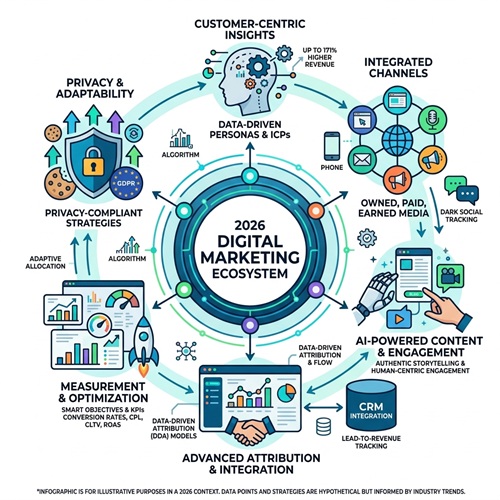
Marketing attribution is crucial to understand which touchpoints contribute to conversions. In 2026, last-click attribution is often misleading. Data-Driven Attribution (DDA) models, often powered by AI, provide a more accurate picture by assigning credit across multiple touchpoints in the customer journey. Integrating your marketing data with your CRM (Customer Relationship Management) system is vital for a holistic view, enabling lead-to-revenue tracking and proving the ROI of your efforts. This integration helps identify the true value of leads from different channels, even accounting for “dark social” – instances where leads discover your brand through private messaging apps, often accounting for 15-25% of primary discovery sources.
Avoiding Common Planning Pitfalls
Even with a solid framework, certain mistakes can derail a digital marketing strategy:
- Focusing on Vanity Metrics: Metrics like social media likes or website page views are meaningless if they don’t translate into business outcomes. Prioritize metrics that directly impact revenue and growth.
- Disconnected Campaigns: Treating digital marketing as a series of isolated tactics rather than an integrated ecosystem leads to fragmented efforts and poor results.
- Siloed Data: Data trapped in separate platforms (e.g., social media analytics, email marketing, CRM) prevents a unified view of customer behavior and campaign performance.
- Ignoring Privacy Changes: With evolving privacy regulations and the deprecation of third-party cookies, failing to adapt your data collection and personalization strategies can lead to compliance issues and reduced effectiveness.
- Lack of Authenticity: In an age where 86% of consumers value authenticity, generic or overly promotional content can alienate your audience. Human-centric storytelling and genuine engagement are key.
By actively addressing these pitfalls, businesses can build resilient and effective digital marketing strategies that deliver consistent, measurable results.
Frequently Asked Questions About Digital Marketing
What is the difference between a digital marketing strategy and a tactic?
A digital marketing strategy is your long-term, high-level plan that outlines your overall goals, target audience, and the general approach to achieve your business objectives online. It’s the “what” and “why.” For example, a strategy might be to “become the leading online resource for eco-friendly products.” A digital marketing tactic, on the other hand, is a specific, short-term action or tool used to execute a campaign that supports your strategy. It’s the “how.” For instance, a tactic for the eco-friendly product strategy could be “publish two blog posts per week on sustainable living” or “run a targeted Instagram ad campaign showcasing new biodegradable packaging.” The strategy provides direction, while tactics are the individual steps taken to move in that direction.
How do emerging trends like generative AI impact strategies in 2026?
Emerging trends like generative AI are profoundly impacting digital marketing strategies in 2026 by enhancing efficiency, personalization, and competitive analysis. Generative AI tools can automate content creation, from drafting ad copy and social media posts to generating email sequences, allowing marketers to scale content production and personalize messaging at an unprecedented level. This frees up human marketers to focus on higher-level strategy, creativity, and oversight. AI also drives more sophisticated predictive analytics, enabling businesses to anticipate customer needs and market shifts. Furthermore, the rise of conversational search means strategies must now account for Generative Engine Optimization (GEO), ensuring content is structured to be easily discoverable and quotable by AI-powered search interfaces. This necessitates a shift towards providing direct, authoritative answers within content to secure visibility in AI-generated search results.
What is a realistic digital marketing budget for a small business?
For small businesses, a realistic digital marketing budget varies widely based on industry, growth goals, and existing resources. A general benchmark suggests that marketing budgets typically account for approximately 9.4% of total company revenue. However, for beginners or startups, a monthly budget starting from $200-$500 might be a viable entry point, focusing on 2-3 core channels like local SEO, social media organic efforts, and email marketing. As the business grows and generates revenue, this budget can be scaled up, with 15-25% of total revenue often allocated for marketing during the growth stage. The key is to start small, track performance rigorously, and incrementally increase investment in channels that demonstrate a positive ROI. Prioritizing owned assets like a well-optimized website and email list, alongside targeted paid efforts, can yield significant returns even on a limited budget.
Conclusion
The digital marketing landscape in 2026 is a complex, rapidly evolving ecosystem driven by data, automation, and artificial intelligence. What was effective just two years ago may no longer yield results. Businesses that thrive are those that embrace a structured, strategic approach, moving beyond disconnected tactics to build integrated, measurable growth engines.
We’ve explored the critical distinction between strategy, campaigns, and tactics, emphasizing that a clear, long-term vision is paramount. We’ve highlighted the core levers of a modern marketing mix, from the foundational power of SEO and content marketing to the immediate impact of paid advertising and the indispensable role of email and video. The pervasive influence of AI and automation, from generative content to predictive analytics and personalization, is undeniable, transforming how we connect with customers and optimize our efforts.
As we look beyond 2026, the future of digital marketing strategies will continue to demand continuous iteration, rigorous testing, and precise attribution. The emphasis will remain on understanding the customer journey, delivering authentic, human-centric storytelling, and maintaining strategic agility to adapt to new technologies and consumer behaviors. By building a robust digital marketing strategy today, businesses can not only compete but truly lead in the digital economy of tomorrow.