Metal fabrication is at the forefront of technological disruption, creating new opportunities for efficiency, customization, and sustainability across industries such as construction, automotive, and aerospace. From intelligent automation to the adoption of advanced materials, modern fabrication shops are rapidly evolving to meet the expectations of a dynamic marketplace. Companies such as Elite Weld & Fab exemplify the shift toward next-generation processes that maximize productivity and pave the way for precision-driven projects.
As manufacturers embrace these innovations, they are not only boosting output and quality but also enabling new product designs and reducing environmental impact. The convergence of robotics, smart factories, and advanced welding is enabling the execution of complex production requirements that were once beyond the reach of traditional facilities. Embracing a holistic approach, forward-thinking metal fabricators are reimagining how projects are initiated, executed, and delivered, dramatically changing the landscape for clients and industry professionals alike.
Continuous improvement is no longer an option, but a necessity for remaining competitive in the face of global pressures and rapidly evolving demands. Those who stay ahead by adopting these technologies are better positioned for long-term growth, increased client satisfaction, and operational resilience.
This transformation reflects a broader trend in advanced manufacturing where digital integration and flexible equipment have created unprecedented agility and scalability in fabrication operations.
Automation & Robotics
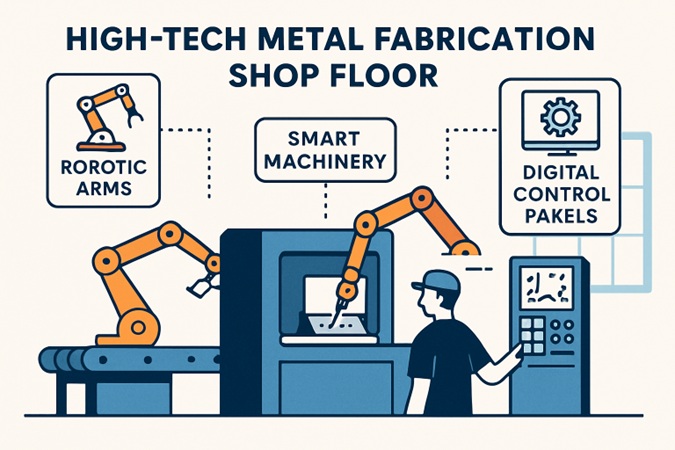
Robotics and automation have transformed the traditional shop floor into a hub for high-volume, precision-driven production. Automated systems now handle repetitive tasks such as laser cutting, welding, bending, and assembly, leading to substantial gains in consistency and output while minimizing labor-intensive processes. By deploying robotics, manufacturers not only reduce human error and injuries but also increase throughput to meet the escalating demands of sectors like automotive and electronics. According to Machine Design, the use of robotics can increase productivity by up to 30 percent in fabrication settings.
Advanced Materials
Material science innovations have introduced new alloys and composites that drive efficiency and sustainability. Lightweight aluminum alloys and ultra-strong carbon composites offer exceptional strength-to-weight ratios, making them ideal for industries that value reduced mass without sacrificing performance. These advancements not only improve fabrication speeds but also support environmentally conscious initiatives by enabling lighter vehicles and machinery, thereby lowering overall emissions. Industries focused on energy savings and durability are leading adopters of these versatile materials.
Additive Manufacturing
Additive manufacturing (AM), known widely as 3D printing, is revolutionizing the creation of complex metal parts. Unlike traditional subtractive methods, AM builds structures layer by layer, allowing intricate internal channels and custom geometries previously unachievable. This technique accelerates prototyping in aerospace and medical device manufacturing, enabling rapid customization and cost-effective production for small batches. Scientific American highlights how additive manufacturing is enabling faster innovation cycles and reducing waste.
Artificial Intelligence In Quality Control
Artificial intelligence (AI) is elevating quality assurance through advanced monitoring and analytics. Machine learning algorithms analyze thousands of data points from welding operations and material inspections, identifying patterns and predicting failures before they affect production. AI-powered vision systems detect defects at every stage, helping manufacturers maintain stringent quality standards while limiting costly rework or recalls. The integration of predictive maintenance with quality control further optimizes equipment lifespan and operational reliability.
Smart Factories & IoT Integration
The adoption of smart factories enabled by Industrial Internet of Things (IIoT) connectivity is enabling real-time, data-driven decision-making. Networked sensors monitor machine conditions, raw material inventories, and energy usage, digitally connecting every component in the manufacturing process. This integrated approach leads to predictive maintenance, optimized workflows, and significant energy savings. Manufacturers leveraging IIoT reduce downtime, improve product traceability, and enhance responsiveness to market needs.
Sustainability Initiatives
Sustainability is now central to modern metal fabrication. Environmental regulations and customer expectations are driving the shift toward greener practices, such as recycling scrap metal, adopting renewable energy sources, and choosing energy-efficient machinery. Closed-loop cooling systems and emissions controls further enhance environmental performance. Companies adopting these practices not only minimize their environmental footprint but also benefit from operational cost savings and improved brand reputation.
Compact & Flexible Equipment
Today’s metal fabricators must respond rapidly to custom orders and shorter lead times. The development of compact multi-function machines enables shops to seamlessly switch between jobs without excessive changeover time or the need to invest in additional machinery. This flexibility makes it easier for small and midsize businesses to compete, driving product innovation and reducing costs for clients in industries from architecture to renewable energy.
Cloud-Based Software Solutions
Cloud-based platforms are reshaping project management and collaboration. These solutions facilitate remote design reviews, instant updates to engineering drawings, and secure file sharing between stakeholders. By leveraging cloud technology, fabrication companies can scale their operations quickly, maintain transparent communication, and accelerate project timelines regardless of team locations. The increased adoption of collaborative software is enabling global partnerships and attracting talent from diverse locations.
Modular Construction
Modular construction, where components are fabricated offsite and assembled onsite, is growing in popularity for its efficiency and cost-effectiveness. This method shortens construction timelines, reduces labor requirements, and limits disruptions at building sites. Metal fabrication plays a crucial role in producing structural frames, facade elements, and interior features that fit together seamlessly in modular assemblies. The approach is portable for medical centers, schools, and housing developments in need of rapid deployment.
Advanced Welding Technologies
Advancements in welding, such as laser beam welding (LBW), friction stir welding (FSW), and pulse welding, deliver precision and strength that surpass those of conventional processes. These innovations enable joining dissimilar materials, reducing heat-affected zones, and achieving high-integrity joints critical to aerospace, automotive, and electronics manufacturing. Advanced welding is instrumental in allowing lightweight designs and achieving consistent quality across complex assemblies.
By adopting these innovative techniques, metal fabrication companies can improve quality, efficiency, and adaptability to meet the future needs of the advanced manufacturing and construction industries.