Key Takeaways:
- Carbon precursor selection depends on the desired final properties, structure, and application.
- Purity, carbon yield, softening behavior, and consistency influence processing outcomes.
- Heat treatment and other processing conditions shape the final material’s performance.
- Testing multiple batches helps verify quality, repeatability, and manufacturing suitability.
- Evaluate total cost, sustainability, and supply reliability alongside material performance.
High-performance carbon is not defined by carbon content alone. It is shaped by the chemistry, purity, physical form, and conversion behavior of the material used at the start of the manufacturing process. Engineers evaluating carbon fibers, electrodes, foams, coatings, or carbon-carbon composites must connect precursor selection to the structure required by the finished part.
That connection is especially clear by mesophase pitch supplier developments, which highlight how precursor properties such as softening behavior, ash content, carbon yield, and molecular order can affect downstream processing. The best option is therefore not a universal material. It is the precursor that fits a defined process and end-use requirement.
What Carbon Precursors Do
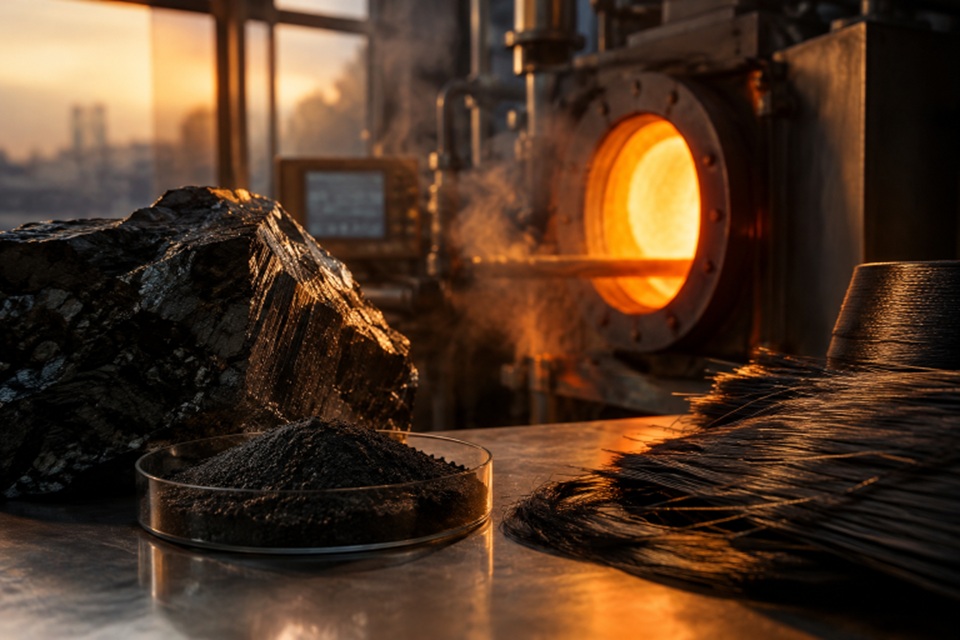
A carbon precursor is a starting material that forms a carbon-rich solid after controlled heating, chemical conversion, or both. During carbonization, much of the non-carbon content is removed as gases or liquids. What remains can be dense, porous, ordered, disordered, conductive, insulating, strong, or relatively fragile, depending on the feedstock and process.
Two feedstocks can have similar carbon levels yet behave very differently because their molecules soften, align, crosslink, volatilize, and shrink differently. That is why selection should begin with the required final properties rather than with the label “carbon precursor.”
Why Structure Matters
Carbon structure controls performance. Molecular order and alignment can support heat and electrical transport in preferred directions. Pore size and surface area can determine whether ions, gases, or liquids can access the material. Particle size, fiber diameter, and density also influence packing, resin infiltration, machining, and mechanical behavior.
Ordered carbon is useful when stiffness, directional conductivity, or thermal management is a priority. More disordered or porous carbon can be useful when a design needs accessible surface area, such as an electrode or filter medium. A heat-spreading component and an energy-storage electrode may both contain carbon, but their ideal internal structures are fundamentally different.
Common Types Of Carbon Precursors
Each precursor group brings trade-offs in cost, handling, consistency, yield, and attainable structure.
- Petroleum-derived materials: Often used in established pitch and coke processing routes where predictable conversion behavior is important.
- Coal-derived materials: Can offer useful coking, binding, or softening characteristics for selected carbon products.
- Aromatic chemical feedstocks: May provide closer control of molecular composition and impurity levels.
- Polymer-based precursors: Commonly considered for fibers, films, coatings, and shaped carbon parts.
- Biomass-derived feedstocks: Include lignin, cellulose, and agricultural residues, whose properties often require careful preprocessing and process development.
Key Factors When Selecting A Precursor
Start With The Final Requirement
Rank the properties that matter most, such as tensile strength, thermal conductivity, electrical conductivity, porosity, chemical resistance, purity, or density. Then identify the operating temperature, mechanical loads, chemical exposure, expected service life, and required part geometry.
Evaluate The Entire Manufacturing Fit
Confirm that the available equipment can achieve the required temperature, atmosphere, pressure, and residence time. Also consider material form, including powder, flakes, pellets, fibers, or chunks. Moisture, ash, volatile matter, particle distribution, storage stability, and batch variation can all influence yield and repeatability. Total cost should include preparation, transport, energy use, waste handling, testing, and scale-up risk.
How Processing Changes The Final Material
Precursor selection and processing cannot be separated. Heating rate, peak temperature, hold time, applied pressure, and furnace atmosphere all affect decomposition, shrinkage, pore development, and carbon ordering. Carbonization converts the feedstock into carbon-rich material. Graphitization uses higher-temperature treatment to increase structural order in suitable materials. Activation creates or enlarges pores, while impregnation introduces a liquid precursor into an existing porous body before further conversion.
Grinding, milling, spinning, molding, coating, and compaction also influence the final shape and microstructure. Record every processing condition during trials. Without a complete process record, comparing one precursor with another can produce misleading conclusions.
Where Advanced Carbon Materials Are Used
Carbon fibers are selected for lightweight reinforcement, while carbon-carbon composites are designed for demanding heat, friction, and thermal-cycling environments. Carbon foams can combine low density with useful thermal or filtration functions. Electrodes need a balance of conductivity, accessible surface area, pore structure, and chemical stability. Carbon-rich binders and coatings can support adhesion, protection, or heat resistance.
For example, a precursor suited to spinning a continuous fiber may favor stable flow and molecular alignment. A porous battery electrode may instead need controlled pore development and accessible surfaces after activation. Choosing the fiber precursor for the electrode without adjustment would ignore the different structure each application requires.
Sustainability & New Feedstock Options
Renewable feedstocks are receiving greater attention, particularly lignin, cellulose, and biomass residues. A recent review of cellulose-derived sustainable carbon materials examines their potential for energy storage technologies beyond lithium-based systems. These materials can offer promising routes to carbon structures, but performance still depends on feedstock composition and conversion conditions.
Renewable origin alone does not establish a lower environmental impact. A meaningful assessment considers collection, transport, purification, chemical inputs, water treatment, energy-intensive heat treatment, emissions controls, product lifespan, and whether the material reduces replacement or maintenance needs in service.
Testing & Quality Control
Screening should match the intended application. Useful measurements include softening or melting behavior, carbon yield, mass loss, ash and trace-element content, particle-size distribution, density, porosity, surface area, electrical and thermal conductivity, and mechanical performance. Optical and structural analysis can help identify whether the desired morphology is developing during processing.
Test more than one production batch. A high surface area may be valuable for an electrode but unnecessary for a structural composite, while a small ash increase may be tolerable in one product and unacceptable in another.
Common Selection Mistakes
- Choosing the lowest-priced feedstock without calculating process yield and quality costs.
- Comparing precursor results produced under different heat-treatment conditions.
- Ignoring moisture, ash, volatiles, and batch-to-batch variation.
- Scaling a laboratory recipe before verifying furnace capacity and process control.
- Optimizing one metric while overlooking durability, manufacturability, and supply reliability.
A Practical Selection Checklist
- Define the part, operating environment, and target service life.
- Rank required material properties in order of importance.
- Confirm equipment, safety, and handling requirements.
- Request current technical and safety data for candidate feedstocks.
- Run small, controlled processing trials using consistent conditions.
- Measure both final performance and conversion yield.
- Compare cost, waste, consistency, and supply-chain risk.
- Repeat trials with additional batches before final qualification.
Final Takeaway
The right carbon precursor follows from the target structure and process, not from a broad category or a single headline property. By testing realistic batches, controlling processing conditions, and evaluating cost and environmental factors together, teams can reduce development risk and build more dependable high-performance carbon materials.