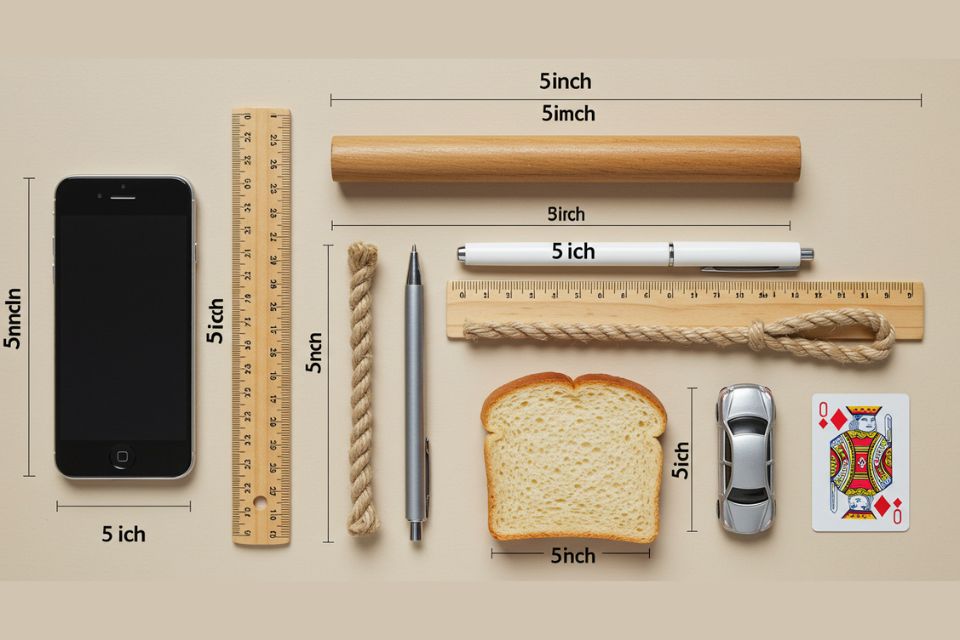
Five inches is a bit harder to picture without the ruler. When compared to familiar objects, however, it is relatively easy to identify. 12.7 centimeters is about the width of an adult hand, so you would see this measurement a lot in day-to-day life. In this post, we have listed everyday things that are 5 inches long to help you make such estimates quickly, so you do not need any tools.
How Long Is 5 Inches In Simple Terms?
The length of 5 inches can be tough to visualize without any measuring tools. Here are a few ways:
- Half the size of an average ruler
- About as wide as an adult hand
- Slightly shorter than most smartphones
- As long as a medium-sized banana
This type of mental reference is handy when precision tools are not at hand.
What Are The Surprising Things That Are 5 Inches Long Around You?
Many objects you use daily fall close to the 5-inch mark, often without you realizing it.
1. Standard Smartphone Width
While smartphones vary in height, many phones measure close to 5 inches across diagonally or in width, depending on the model. This makes phones a convenient size reference when estimating small spaces.
2. Computer Mouse
Most standard computer mice are approximately 4.5 to 5 inches long. Since people use them daily, they offer a reliable mental image of this length.
3. Sticky Notes Pad
A typical square sticky note pad measures 3 x 3 inches, but stacked pads or rectangular note pads often reach close to 5 inches in length.
4. TV Remote Control (Mini Versions)
Compact or smart TV remotes are often around 5 inches long, especially minimalist designs for streaming devices.
5. Sunglasses Case
Slim sunglasses cases, particularly hard-shell or travel-friendly designs, are commonly close to the 5-inch range.
6. Handheld Makeup Products
Items like mascara tubes, compact brushes, or lip gloss containers frequently measure around 5 inches, making them perfect pocket-sized accessories.
Why Knowing The Size Of 5 Inches Is Useful?
Knowing what 5 inches look like is helpful in a wide variety of real-life situations, including:
- Online shopping: Estimation of size before purchase
- Travel: Testing to see if objects fit into pouches or pockets
- Do-it-yourself projects: Guessing at measurements without a ruler
- Organization: Perfect storage containers
Being able to eyeball measurements saves time and reduces mistakes.
What Are The Common Mistakes People Make About 5 Inches?
Although it sounds easy, people are wrong about this measurement most of the time.
- Making 5 inches and centimeters (which are infinitely less).
- Suppose that it is the same as a hand span to all.
- Assuming that its size is larger than the screen measurements.
Real-world objects are used as an object of reference to eliminate these errors.
How To Measure 5 Inches Without A Ruler?
In case you lack a measuring device, the following are quick methods of doing it:
- Use the width of your palm
- Compare it to a computer mouse or smartphone
- Stack two credit cards end-to-end for an estimate
The tricks are particularly applicable in ordinary circumstances.
Conclusion
In spite of its small size, 5 inches is a very popular measure in everyday life. Most things around you are close to this size, including tech accessories and personal things, household tools, and so on. After using familiar references, trying to visualize 5 inches becomes very easy and automatic. Such a tiny ability can help make decisions so quicker, easier, and more precise without measuring tools to be used on a daily basis.
FAQs
How long is 5 inches compared to daily objects?
A computer mouse, a remote control, or a smartphone is just five inches or about the size of one.
Is 5 inches bigger than a hand?
This is based on the size of the hand, though in most adult cases, the palm width is between 5 inches
How many centimeters is 5 inches?
Five inches equals 12.7 centimeters.
Can I measure 5 inches without tools?
Yes, you can estimate it with the help of objects, such as a phone, a mouse, or your palm.
Why is it useful to know what 5 inches looks like?
It is useful in fast size estimation when shopping, sorting, crating, or in minor tasks that require DIY activities.